
Quiz or game? Choosing the right format for a knowledge check
A plain quiz and a quiz game test the same knowledge, but they get very different behaviour from learners. Here is how the two compare on completion, practice, feedback and data — and when to use each.
The Arcadedo team, Gametize
3 min read

Use a plain quiz when you need a formal, one-off assessment; use a quiz game when you want people to practise until they know it. Both ask the same questions. The difference is behaviour: a quiz is taken once, as fast as possible, while a short game is played, replayed and talked about — and every replay is another round of recall practice.
Side-by-side comparison
| Plain quiz | Quiz game | |
|---|---|---|
| Best for | Formal assessment, certification | Practice, refreshers, awareness |
| Typical attempts | One | Several (people replay to improve) |
| Learner mindset | "Get through it" | "Beat my score" |
| Feedback | Often only at the end | After every answer |
| Time per attempt | Varies, often long | Two to three minutes |
| Setup effort | Low | Low with a template |
| Data | Final score | Per-question misses, pass rates over attempts |
Where plain quizzes win
- Formal assessment. If the result goes on a record, a plain quiz is clearer and easier to defend. No timers, no lives, no ambiguity about what was measured.
- Long or complex questions. Scenario questions with paragraphs of context do not belong in a racing game.
- Accessibility requirements that rule out time pressure. A plain form is the most accessible format there is.
Where quiz games win
More practice per learner
The most valuable thing a knowledge check can do is make people retrieve the answer from memory — and do it again later. A two-minute game invites replays in a way a form never does.
Feedback at the moment it matters
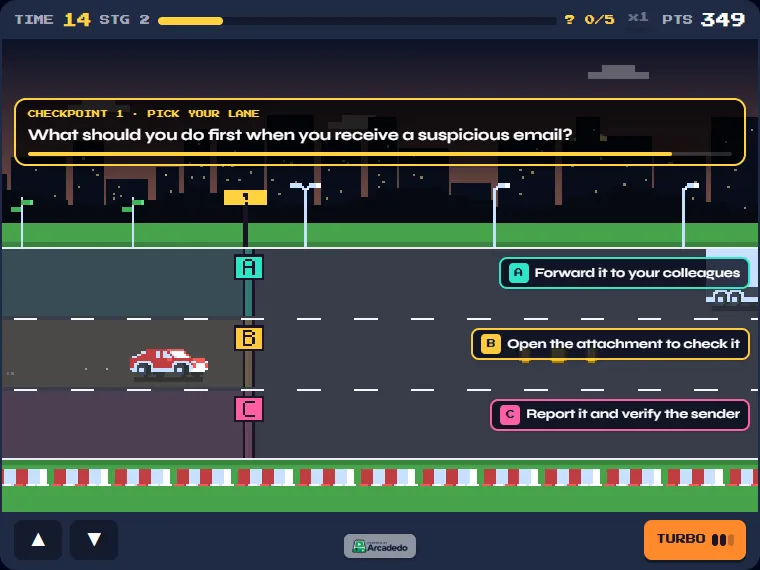
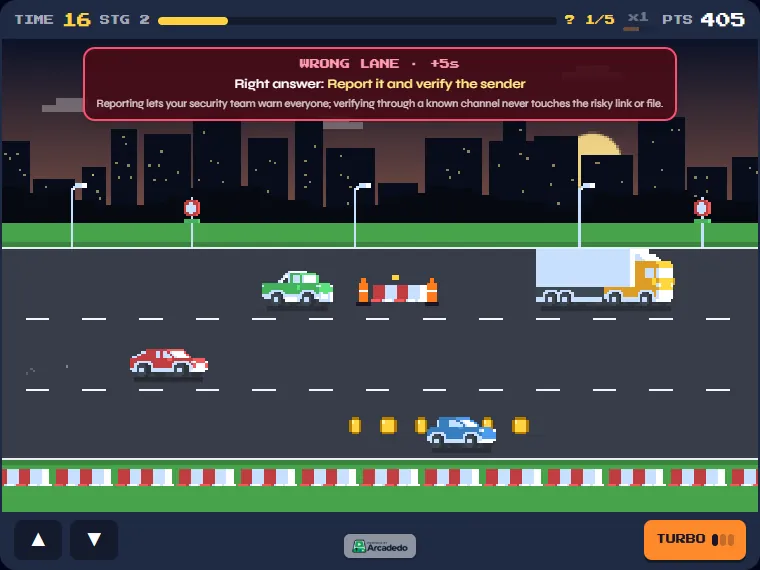
Games like Turbo Quiz Racer and Checkpoint Rush show an explanation straight after each answer, while the learner still cares about the question. Missed questions come back on the results screen with the right answer.
Better signal on what people do not know
Because people play more than once, you see which questions they keep missing, not just who passed. That is the information you need to fix the training material.
Willing participation
Optional training only works if people choose to do it. A branded game embedded in a campaign gets played; an optional quiz mostly does not.
A practical approach: use both
- Teach with your normal course, video or session.
- Practise with a short quiz game, available to replay for a week or two.
- Assess, if you need to, with a plain quiz at the end.
The game does the heavy lifting; the formal quiz just confirms it.
Choosing a game format
Different templates suit different kinds of question:
- Recall of facts and rules — Turbo Quiz Racer, Dino Run, Space Shooter.
- Quick judgement calls — Real or Fake.
- Lots of short facts — Star Match.
- Recognising terms — Word Search.
Our template guide compares all of them.
Frequently asked questions
Do games make knowledge checks less rigorous?
Not if the questions are good. The question, the right answer and the explanation are the same; the game changes how often people practise and how they feel about it.
Will time pressure hurt some learners?
It can. Keep pass marks reasonable, allow replays, and use a plain quiz for any formal assessment where time pressure would be unfair.
Can I use the same questions in both formats?
Yes. Many teams draft questions once, use them in a game for practice, and reuse them in a formal quiz at the end.