What is gamified learning? A practical guide for training teams
Gamified learning wraps training content in game mechanics — goals, feedback, scores and a little pressure — so people practise recall instead of skimming. Here is what it is, when it works, and how to start in an afternoon.
The Arcadedo team, Gametize
4 min read

Gamified learning is training delivered through game mechanics — a clear goal, instant feedback, a score, a timer, a reason to try again. Instead of reading a policy and clicking "I understand", a learner answers questions while racing a car, dodging traffic or clearing a maze. The content is the same; the difference is that the learner has to use it, repeatedly, under light pressure. That is what makes it stick.
This guide covers what gamified learning actually is, why it works, where it fits in workplace training, and how to build a first game without a developer.
Gamified learning vs game-based learning
The two terms get used interchangeably, but they describe different things:
- Gamification adds game elements — points, badges, leaderboards, levels — to an activity that is not a game. A Gametize campaign that rewards people for completing challenges is gamification.
- Game-based learning puts the content inside a game. The learner plays, and the questions or facts are part of the play itself.
Arcadedo sits on the game-based side: each template is a complete arcade game, and your questions, facts or word lists are what it runs on. In practice the two work best together — a short game embedded inside a gamified campaign, so the game supplies the practice and the campaign supplies the reasons to come back.
Why game mechanics help people learn
None of this is magic. Games simply make it easy to do the things learning research has recommended for decades.
Retrieval practice
Pulling an answer out of memory strengthens it far more than re-reading it. A quiz game is retrieval practice that people volunteer for: every checkpoint, every star tile, every golden egg is a question they have to answer from memory.
Immediate, specific feedback
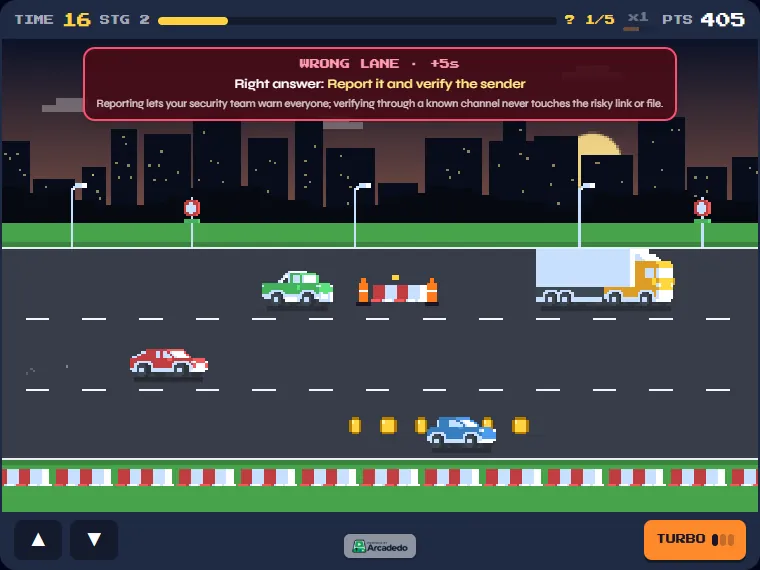
In a game you know at once whether you were right. Good learning games go further and explain why. In Turbo Quiz Racer, every answer is followed by a short explanation, so a wrong guess becomes the moment the learner finds out the right answer.
Repetition without boredom
Nobody re-reads a compliance document three times. Plenty of people replay a two-minute game to beat their score. Each replay is another round of practice.
A safe place to fail
A crash in a racing game costs a life, not a disciplinary note. Learners can test their judgement — "is this email a scam?" — and get it wrong where it does not matter.
Where gamified learning works best
Short arcade games are not a replacement for every course. They shine when the goal is recall, recognition or quick judgement:
| Training need | Why a game fits | Template to try |
|---|---|---|
| Compliance refreshers | Same facts every year; practice beats re-reading | Turbo Quiz Racer |
| Cyber security awareness | Spotting a fake is a fast judgement call | Real or Fake |
| Onboarding | Lots of new terms and facts in one week | Mini Maze |
| Product knowledge | Features, specs and answers sales teams need on recall | Star Match |
| Key vocabulary | Terms people need to recognise | Word Search |
| Events and campaigns | Engagement first, learning second | Spin the Wheel |
They are a weaker fit for deep conceptual material, long procedures, or anything that needs discussion. Use a game to drill and check; use a workshop or a course to teach the hard parts.
How to build your first learning game
You can have a branded, playable game in front of learners in an afternoon:
- Pick one outcome. "New joiners can name our five security rules" beats "improve security culture".
- Choose a template that matches the kind of thinking you want — recall, judgement or recognition. Our guide to choosing the right template walks through each one.
- Write five to ten questions. Or upload the policy as a PDF or Word document and let AI draft them, then edit. See Add questions or facts.
- Add explanations. One sentence on why the right answer is right does more for learning than any number of extra questions.
- Brand it with your logo and colours so it feels like part of your programme, not a third-party toy. See Brand your game.
- Publish and embed it where learners already are — for example a Gametize campaign. See Embed in Gametize.
- Read the analytics and rewrite the questions most people miss.
For a full walkthrough, read how to turn a quiz into an arcade game.
Common mistakes to avoid
- Too many questions. A game that takes fifteen minutes is a test wearing a costume. Keep runs to two or three minutes and let people replay.
- Trick questions. They punish attention, not knowledge. Make the wrong options plausible, not sneaky.
- No explanations. Without feedback a learning game is just a scoreboard.
- Treating the score as the outcome. The score tells you who played; the per-question analytics tell you what people still do not know.
Frequently asked questions
Is gamified learning only for younger employees?
No. Short, low-stakes games with clear rules work across age groups. What matters is that the game is quick to understand and respects people's time — which is why arcade formats, with one mechanic each, work so well.
Does gamified learning replace e-learning courses?
It complements them. Use a course to introduce material and a game to practise and check it, ideally a few days later and again a few weeks after that.
How long should a learning game be?
Two to three minutes per run is a good target, with five to ten questions. Short runs invite replays, and replays are where the practice happens.
Do I need a developer or a game designer?
Not with a template-based tool. In Arcadedo you fill in forms — questions, colours, logo — and the game, hosting and embed link are handled for you. Building and hosting games is free.
How do I measure whether it worked?
Look past completion rates. Per-question results show which facts people still get wrong, and pass rates over repeated plays show whether knowledge is improving.