
Kahoot alternatives for corporate training: six options by use case
Six Kahoot alternatives for corporate training, grouped by the job you need done: live sessions, self-paced practice or a recorded result. With current free-plan limits, an honest Arcadedo comparison and when to stay with Kahoot.
The Arcadedo team, Gametize
9 min read

The best Kahoot alternative for corporate training depends on why Kahoot does not fit. For live sessions with a more professional look, use Mentimeter, Slido or AhaSlides. For self-paced practice that staff replay on their phones, use a game builder such as Arcadedo or The Training Arcade. For a recorded result per person, use your LMS.
Most lists of Kahoot alternatives are written by a competitor, name fifteen tools and rank their own first. This one is also written by a vendor, so here is the bias up front: Arcadedo is our product, it is not a live quiz tool, and for several of the jobs below it is the wrong choice. The guide sorts six options by the job you need done, and every price and limit is taken from the vendor's own site as listed on 12 October 2026. Check the linked pages before you buy, because plans change.
Why do corporate trainers look for a Kahoot alternative?
Trainers usually look elsewhere for one of four reasons: the per-presenter annual licence, a look and sound that feels too playful for the topic, a format built around a live host when staff are on shifts or in different time zones, or the need for practice people repeat instead of a one-off session.
Kahoot is a good product, and its business edition, Kahoot! 360, describes itself as a "workforce engagement platform" with training, onboarding and events among its use cases (kahoot360.com). The reasons to look elsewhere are about fit:
- Cost per presenter. Kahoot! 360 plans are billed annually and need one licence per presenter. The pricing page lists Pro Start at $19 per month for up to 50 participants per session, Pro Standard at $25 for up to 200 and Pro Plus at $39 for up to 1,000 (Kahoot! 360 pricing).
- Tone. A countdown, music and a podium suit a kick-off. They suit a session on harassment or a data breach less well.
- Live by design. Kahoot does offer self-paced assignments with a deadline, but the product is built around a host presenting to a room.
- One session, one attempt. A live quiz is played once. Recall improves with repeated practice spread over time, which is the case we make in our guide to gamification in employee training.
What are the best Kahoot alternatives for corporate training?
The best alternatives fall into three groups: live audience tools (Mentimeter, Slido, AhaSlides), self-paced game builders (Arcadedo, The Training Arcade) and school-first quiz platforms that some companies reuse (Wayground, formerly Quizizz). Choose the group first, then the tool. A live tool cannot fix a self-paced problem, and the reverse is also true.
| Tool | What it is | Best for | Free plan, as listed on 12 Oct 2026 |
|---|---|---|---|
| Mentimeter | Live polls, quizzes and word clouds inside a presentation | Workshops and town halls that need a calm, professional look | Yes: 50 participants per month |
| Slido | Live Q&A, polls and quizzes for meetings | All-hands and meetings where questions matter more than scores | Yes: Basic plan, up to 100 participants per event |
| AhaSlides | Interactive slides with quizzes and polls | Trainers who want Kahoot-style energy inside their own deck | Yes: 50 live participants |
| Arcadedo | No-code builder for short branded arcade games | Self-paced practice and refreshers that people replay | Yes: building, hosting and publishing are free |
| The Training Arcade | Twelve training game templates, including licensed JEOPARDY! and Wheel of Fortune | Larger L&D teams that want game-show formats | Free trial; annual subscription |
| Wayground (formerly Quizizz) | Self-paced and live quizzes, built for schools | Teams that already know it from teaching | Free sign-up for teachers; business use needs a conversation |
Your LMS is the seventh option, and the right one whenever a named person's score has to go on a record.
Which Kahoot alternatives work best for live training sessions?
For a live session, pick Mentimeter for a polished workshop, Slido when audience questions are the point, and AhaSlides when you want quiz competition inside your own slides. All three run from a join code on the participant's phone, like Kahoot, and all three have a free plan large enough to test with a real team.
- Mentimeter calls itself an audience engagement platform. Its free plan allows 50 participants per month, and paid plans are listed at $11.99 (Basic) and $24.99 (Pro) per presenter per month, billed yearly.
- Slido is strongest at Q&A and quick polls in meetings, with quizzes as an extra. Its free Basic plan hosts up to 100 participants per event, according to Slido staff in the Slido community; check the pricing page for poll limits before a large event.
- AhaSlides is the closest to Kahoot in feel. Its free plan allows 50 live participants, with up to five quiz questions and three poll questions in a presentation.
If you run live sessions every week for large groups and like Kahoot's format, the honest answer may be to stay; see "When should you stay with Kahoot?" below.
Which Kahoot alternatives work for self-paced training?
For self-paced training, use a tool designed to be played alone and replayed: a game builder such as Arcadedo or The Training Arcade, or the quiz in your LMS when the score must be recorded. Self-paced play removes the host, the meeting invite and the time zone problem, and lets people practise more than once.
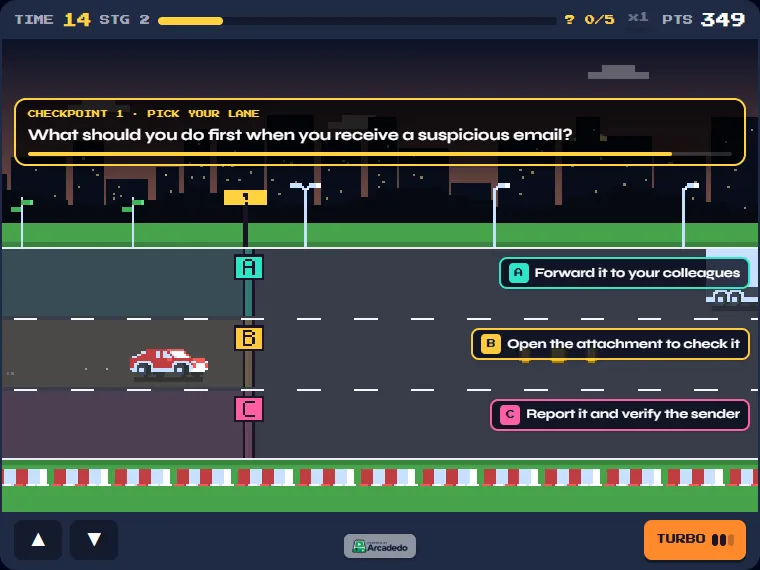
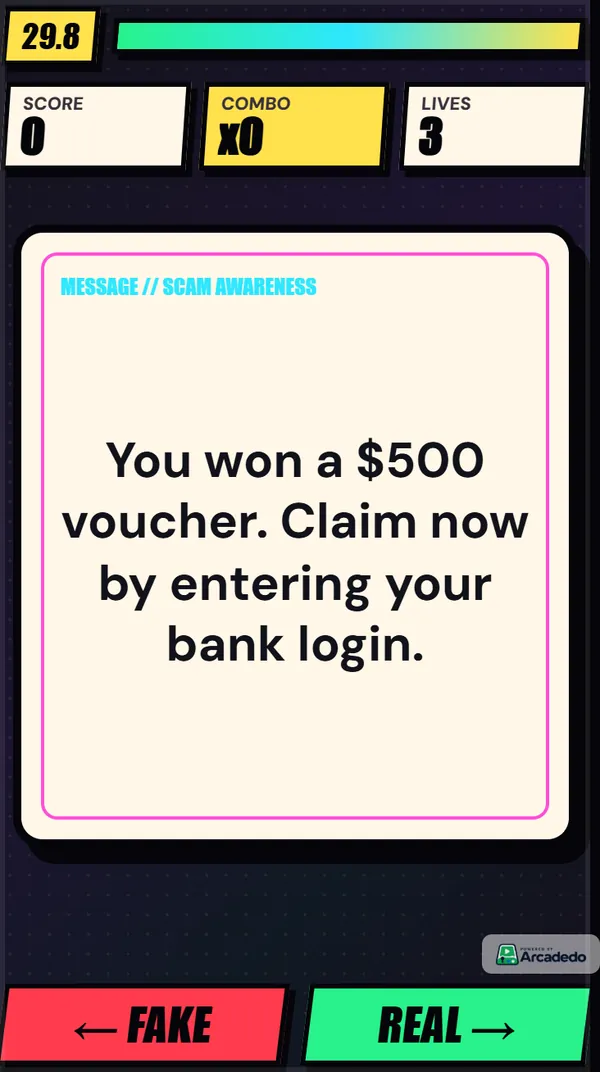
Arcadedo turns your questions into a short arcade game with your logo and colours. There are eleven templates, including a quiz race (Turbo Quiz Racer), a highway racer (Checkpoint Rush), a swipe-to-judge deck (Real or Fake), a match-3 board, a word search and a prize wheel, and each one can be played in the browser before you sign up. You share one link; players need no account and no app.

The Training Arcade, from ELB Learning, offers twelve templates you fill with your own content, including licensed JEOPARDY! and Wheel of Fortune games. It is sold as an annual subscription with a free trial, and suits teams with a budget and a taste for game-show formats.
Wayground is the new name for Quizizz. It supports self-paced quizzes with a due date, and its site is aimed at teachers, schools and districts. Some companies use it; ask the vendor about business terms first.
Not sure which Arcadedo format fits your content? Our guide to choosing a game template compares them, and how to turn a quiz into an arcade game walks through the build.
How does Arcadedo compare with Kahoot?
Kahoot is a live quiz show that a presenter hosts for a group; Arcadedo is a self-paced arcade game that each person plays alone from a link and replays to beat their own score. They overlap on the questions and differ on almost everything else, so many teams use both: Kahoot in the room, a game afterwards.
| Kahoot! 360 | Arcadedo | |
|---|---|---|
| Built for | Live, hosted sessions (self-paced assignments also available) | Self-paced play from a link |
| Who plays together | The whole group, on the same question, against the clock | One player at a time, in their own time |
| Presenter needed | Yes, for live games | No |
| Format | Quiz and audience interaction | Eleven arcade templates: racers, match-3, swipe deck, word search, prize wheel |
| Feedback | Scores and a podium during the session | Your explanation after every answer |
| Results | Session reports; identifying individual players depends on your plan | Anonymous totals: plays, completion rate, pass rate, most-missed questions |
| Price | Annual licence per presenter, from $19 per month | Free to build, host and publish; optional one-off credit packs from $9 |
What Arcadedo does not do: there is no live host mode, no shared podium for a room, and no named score per person. If you need any of those, it is not your Kahoot replacement.
What it does well: quiz games show your explanation after each answer, a published game keeps the same link when you edit it, and AI can draft the questions from a policy or deck you upload (Add questions or facts). Credits pay only for AI help and for removing the small Arcadedo badge; see how credits work.
When should you stay with Kahoot?
Stay with Kahoot when your training is live, your groups are large and the energy in the room is the point: kick-offs, conferences, onboarding days and team events. It is a mature product, most people already know how to join, and its paid plans scale to thousands of participants in a session.
Stay, too, if your team already uses its self-paced assignments and reports and they answer your questions. Switching tools costs time, and a new tool will not fix weak questions. Look elsewhere when the session format is the problem: nobody can attend at the same time, the tone is wrong for the topic, or people need to practise more than once.
How do you choose a Kahoot alternative?
Start from the session, not the feature list. Decide whether people will play together or alone, whether the result must be tied to a name, and how many presenters need a licence. Those three answers remove most of the options before you compare a single price.
- Live or self-paced? Live: Mentimeter, Slido, AhaSlides or Kahoot. Self-paced: a game builder or your LMS.
- Does a named score need to be recorded? If yes, use your LMS or a tool with identified reporting. If no, anonymous totals are enough and far simpler to roll out. Our comparison of a quiz or a game as a knowledge check covers the trade-off.
- Who builds the content? Per-presenter pricing adds up when ten trainers each need a licence. Count the builders before you count the players.
- What is the topic? For rules and policies, pick a format with an explanation after each answer; see compliance training games.
- Test with real people. Build five questions on the free plan, send them to one team and watch whether anyone plays twice.
To try the self-paced route, open the game templates, play one, then follow Create your first game.
Frequently asked questions
Is Kahoot good for corporate training?
Yes, for live sessions. Kahoot! 360 is built for workplace training, onboarding and events, and it works well when a presenter runs a quiz with a group. It fits less well when staff cannot attend at the same time or need to practise the same material several times.
How much does Kahoot cost for business?
On 12 October 2026 the Kahoot! 360 pricing page listed Pro Start at $19 per presenter per month for up to 50 participants per session, Pro Standard at $25 for up to 200 and Pro Plus at $39 for up to 1,000, all billed annually. A free account is available for testing.
What is the best free Kahoot alternative for work?
For live sessions, Mentimeter and AhaSlides both list free plans for up to 50 participants. For self-paced practice, Arcadedo is free to build, host and publish, with no limit on the number of games. Free plans change often, so check each pricing page.
Can you use Kahoot for self-paced training?
Yes. Kahoot lets you assign a kahoot with a deadline, and participants answer on their own devices at their own pace. Whether reports can identify each participant depends on your plan. If self-paced practice is your main need, compare it with tools built for that first.
Is Arcadedo a live quiz tool like Kahoot?
No. Arcadedo makes self-paced arcade games that each person plays alone from a link. There is no host, no join code and no shared podium. Use it for practice and refreshers before or after a live session, and keep a live tool for the room.