Safety training games: how to build one your team will replay
How to turn your own safety procedures into short games workers replay: which hazards suit a game and which need hands-on training, four formats that fit, how to write scenario questions, and what to measure afterwards.
The Arcadedo team, Gametize
9 min read

Safety training games are short games that make workers practise your safety rules: picking the right first action in an incident, spotting the hazard, judging a safety myth. Build them from your own procedures, keep runs to two or three minutes, show an explanation after every answer, and keep hands-on training where regulations require it.
Search for safety games and you mostly find two things: lists of party games for a toolbox talk (safety bingo, an obstacle course, Jeopardy on a whiteboard) and agencies offering custom 3D simulations. Both have their place. This guide covers the gap between them: turning the rules on your own site into a two-minute digital game this week, being clear about what a game cannot do, and reading the results. The examples use Arcadedo templates you can play in a browser before you build anything.
What are safety training games?
Safety training games are short, replayable games built around the rules that keep people safe at work: emergency procedures, hazard spotting, PPE, manual handling, reporting near misses. Instead of watching a video and signing a sheet, workers make the decisions inside a game and see why each answer is right or wrong.
They come in three broad kinds:
- Live activities run by a trainer: safety bingo, quizzes in a toolbox talk, team challenges. Good for energy, limited to the people in the room.
- Custom simulations: a virtual site or a VR scenario. Realistic, and usually months of work and a large budget.
- Short games built from your own content: your procedures, your site, your near misses, put into a game template. Anyone can play them on a phone between shifts and replay them.
This guide is about the third kind. For the wider picture, start with our guide to gamification in employee training.
Do safety training games work?
Games help safety training when they make workers actively use the rules: choose, act, get feedback, try again. The strongest evidence is about engagement in that sense, not about points. A large review of safety training found that the more actively people took part, the more they learned, and the better their safety outcomes.
What the research says, and how far it goes:
- Active beats passive. Burke and colleagues pooled 95 studies of worker safety and health training with about 21,000 participants. More engaging methods, with practice and feedback, produced greater knowledge gains, and reported accidents, illnesses and injuries fell further as engagement rose (American Journal of Public Health, 2006). The most engaging methods in that review were hands-on training and behavioural modelling, not games, so read it as support for active practice in general.
- Gaming in a safety course is promising but early. A randomised field trial with 77 workers added a gaming session to a one-day safety course. Knowledge improved significantly, though the control group improved too, and the authors call for long-term studies (La Torre et al., 2026, Annali di Igiene).
- Spacing matters at work. A study of more than 10,000 employees found that the gaps between practice sessions mattered more the longer the delay before the test (Kim et al., 2019). Short games that people replay over weeks are an easy way to space practice.
The honest summary: a game is a good way to get people to practise the rules repeatedly. Nobody has shown that a quiz game on its own reduces injuries, so do not promise that in your business case.
Which safety topics suit a game, and which do not?
Topics with clear rules and recognisable situations suit a game: the first thing to do in a fire, which sign means what, when to stop and report. Skills that depend on the body or a machine, such as operating a forklift or using a harness, need hands-on practice and an assessor. Use the game to refresh the rules around them.
| Topic | What workers should be able to do | Format that fits |
|---|---|---|
| Emergency response | Pick the right first action in a fire, spill or injury | Action quiz (Outpost Defense) |
| Hazard spotting | Choose the safe option quickly, under light pressure | Highway quiz (Checkpoint Rush) |
| Safety myths and shortcuts | Tell a real rule from a common myth | Swipe to judge (Real or Fake) |
| PPE and site rules | Recall what is required, where and when | Quiz race (Turbo Quiz Racer) |
| Near-miss reporting | Know who to tell, how and how fast | Quiz race or highway quiz |
| Equipment operation | Operate it safely | Not a game: hands-on training and evaluation |
The last row matters. In the United States, for example, OSHA's rule for powered industrial trucks says operator training must combine formal instruction, practical training and an evaluation of the operator's performance in the workplace, with a re-evaluation at least every three years (29 CFR 1910.178(l)). A game can be part of the formal instruction. It cannot be the practical part.
Which game formats work for safety training?
Use a format where every answer has a consequence and an explanation. Outpost Defense suits emergency procedures because each correct answer earns an upgrade for the next wave. Checkpoint Rush turns a hazard question into a driving decision. Real or Fake fits myth-busting, and Turbo Quiz Racer is the plain, calm option for rules people must recall.
Action quiz (Outpost Defense). Players defend an outpost from waves of critters. Clear a wave and a supply crate drops with one of your questions: answer correctly to pick an upgrade such as a shield or a turret; answer wrongly and see the right answer and its explanation. Missed questions come back on the results screen. Five waves ask four questions; you can set from three to eight. See how to build an Outpost Defense.
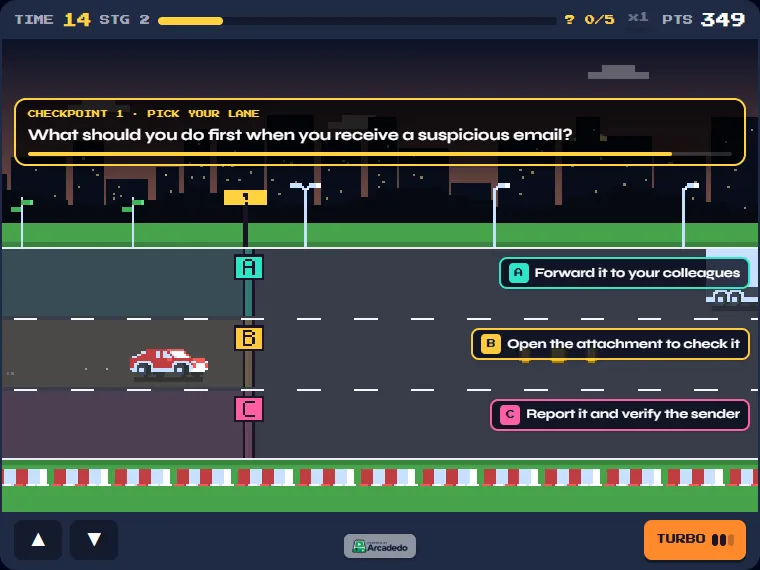
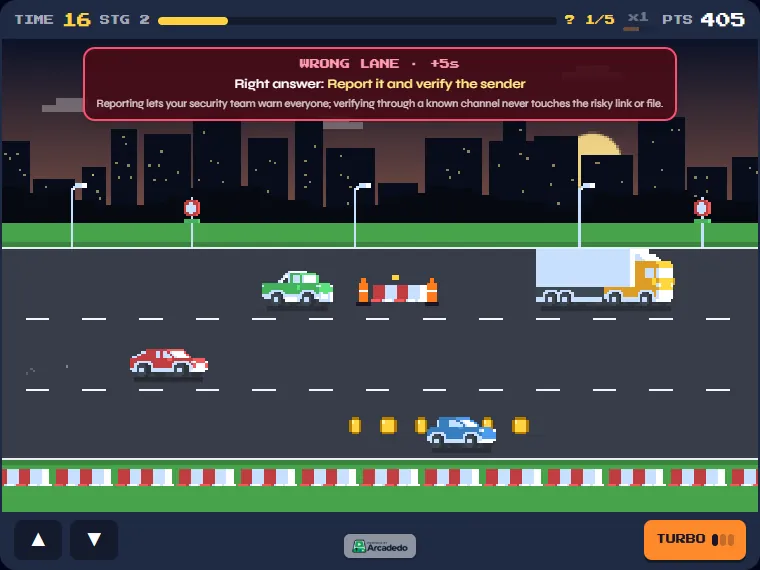
Highway quiz (Checkpoint Rush). Players weave through traffic, road works and oil slicks. At quiz checkpoints the three lanes become three answers. A wrong lane means a traffic jam and the right answer on screen straight away, which is exactly when people pay attention.
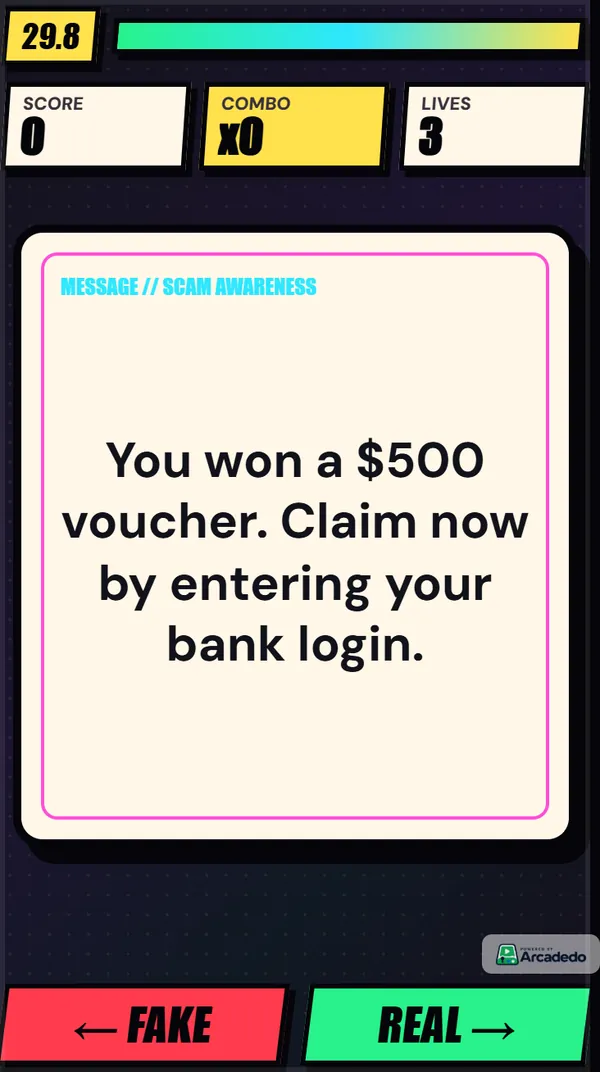
Swipe to judge (Real or Fake). Each card is a statement; players swipe right for real and left for fake. Safety is full of myths worth busting ("Gloves make it safe to clear a jammed machine while it is running"), and each card can show the tell that gives it away. The sample deck below is about scams; yours would hold your site's myths.
Quiz race (Turbo Quiz Racer). Each correct answer moves the player's car toward the finish; a wrong one costs a life and shows the explanation. Lives, timers and the pass score are adjustable, so it can be gentle for a first run. Our guide to choosing a game template compares every format.
How do you build a safety training game, step by step?
Choose one safety outcome, open a quiz template, add five to ten scenario questions from your procedures, write a one-line explanation for each, brand it, set a pass score and publish. In Arcadedo that takes under an hour with no code, and the link plays on any phone, which matters for workers who are not at a desk.
- Choose the outcome. One behaviour per game, agreed with your safety lead. "Everyone knows the three steps when the fire alarm sounds" makes a focused game; "be safe" does not.
- Open a template. Go to the game templates, click Preview & Play to try one, then Use This Template.
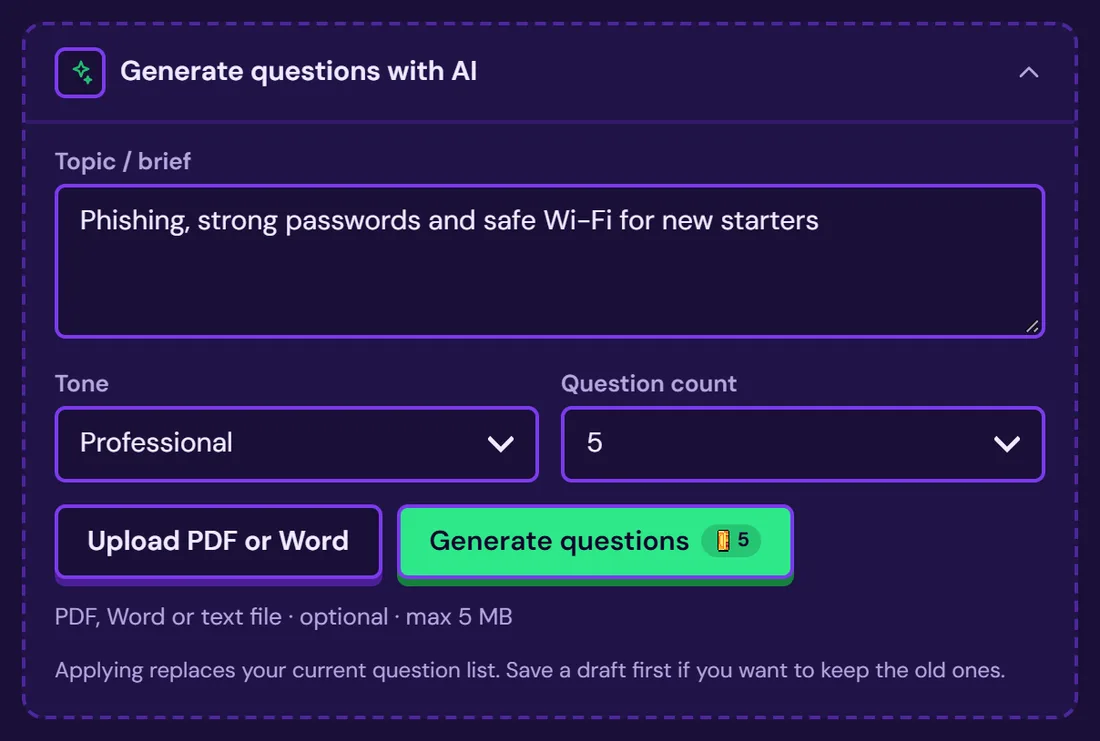
- Add the questions. Write them yourself in the Content step, or click Generate with AI and upload your procedure as a PDF, Word or text file up to 5 MB. Generating costs 5 credits per batch, refunded if it fails. See Add questions or facts.
- Check every question with the safety lead. An AI draft is a starting point. A wrong answer in a safety game teaches the wrong thing, so the person who owns the procedure signs off the final set.
- Write the explanations. One sentence per question saying why: "Raise the alarm first, so everyone else starts moving while you deal with the fire."
- Brand it and publish. Add your logo and colours so it is clearly an official exercise (Brand your game), set a pass score around 70 to 80 percent, publish from the Go step and share the link in WhatsApp, Teams or email, where shift workers will see it.
If your procedures live in a long PDF, our guide to turn a PDF policy into a quiz game shows how to prepare the file and check the drafted questions.
How do you write safety questions that test what people do?
Ask what the person does next, in a situation they will recognise, not what the manual says. "You smell gas in the plant room. What do you do first?" tests the procedure the way workers meet it. "Which section covers gas leaks?" tests nothing useful. Write the wrong answers from the shortcuts people really take.
A few rules:
- Use your own near misses, anonymised. They are the situations your people actually face.
- Make every wrong answer tempting. "Finish the job, then report it" is the real mistake; "Ignore it" is too obvious to teach anything.
- Name the reason in the explanation. "Isolate the power before clearing a jam: the machine can restart without warning" beats "Correct!".
- Avoid trick wording such as "which is NOT". Under time pressure it catches people who know the rule.
How do you roll out and measure a safety game?
Launch the game alongside your induction or toolbox talk, send it again two to four weeks later, and refresh the questions after incidents or procedure changes. Then read the game's analytics: completion rate, pass rate and the most-missed questions. The most-missed questions show which rules have not landed.
A simple cadence:
- Week 0: the induction, course or toolbox talk, with the game as the practice step at the end.
- Weeks 2 to 4: a reminder with the same link. Short runs invite replays, and each replay is more practice.
- After an incident or a change: add a question about it. A published game keeps the same link, so nobody needs a new invitation.
Treat the game as practice, not as your training record. Arcadedo's analytics are anonymous totals and do not record which named worker passed, so keep formal completion and competence records in your LMS or training register. Our comparison of a quiz or a game as a knowledge check covers when each is the right tool, and our guide to compliance training games uses the same split for policy topics.
Frequently asked questions
What are some fun safety games for work?
For live sessions: safety bingo, a hazard-spotting photo hunt and a quiz in the toolbox talk. For practice people can do on their own phones: short digital games built from your procedures, such as a quiz race, a highway quiz where lanes are answers, or a myth-or-fact swipe deck. Mix one live activity with a game people can replay.
Can a game replace hands-on safety training?
No. A game can refresh rules and decisions, but skills such as operating machinery, working at height or first aid need practical training and, often, a formal evaluation. Some regulations require it, such as OSHA's rule for forklift operators. Use the game before and after the practical session.
How many questions should a safety training game have?
Five to ten, covering one outcome. A run of two or three minutes gets replayed; a long one gets abandoned. Split a long procedure into several short games, one per hazard or situation.
How much does it cost to build a safety game in Arcadedo?
Building, hosting and publishing a game is free. Credits pay only for optional extras: 5 credits per batch of AI-drafted questions, and credits to remove the small Arcadedo badge. See how credits work.