
How to write multiple-choice questions for training
Write each question from one learning objective, as a short scenario with a clear stem. Use real mistakes as the wrong answers, keep options short and parallel, skip "all of the above" and add an explanation. Rules, before-and-after rewrites and a checklist.
The Arcadedo team, Gametize
8 min read

Write each multiple-choice question from one learning objective, as a short scenario with a stem people could answer before they see the options. Give one clearly right answer and two or three wrong answers taken from mistakes people really make. Keep the options short and alike, skip "all of the above", and add a one-line explanation.
Most training quizzes fail in the same few ways. They test a page number instead of a decision, they give away the answer with one silly option, or they hinge on a trick word. This guide covers the rules that fix that, with before-and-after rewrites and the research behind each rule. The last section covers what changes when the quiz is a game.
How do you write a good multiple-choice question?
Start from what the person must do after the training, not from the document. Write one question per behaviour, phrased as a situation they will meet. Put the whole question in the stem, then write the right answer, then wrong answers from real mistakes. Finish with a short explanation, and have someone who knows the topic check it.
- Pick the objective. "Report a lost laptop within an hour" is an objective. "Know the device policy" is not.
- Write the stem as a situation. "You leave your laptop on the train. What do you do first?"
- Write the right answer. One answer an expert would choose without arguing.
- Write two or three wrong answers. Each one a mistake you have seen people make.
- Write the explanation. One line on why the right answer is right.
- Check it. Ask the policy owner or a subject expert to read it before you publish.
These steps follow the most widely used set of item-writing rules, a review of textbooks and research that boiled the advice down to 31 guidelines (Haladyna, Downing and Rodriguez, 2002, Applied Measurement in Education). The sections below cover the ones that matter most for workplace training.
What makes a good question stem?
A good stem asks one clear question and holds all the information needed to answer it. A reader who knows the topic should be able to answer from the stem alone, before reading any option. Keep it short, phrase it positively, and put shared wording in the stem rather than repeating it in every answer.
| Weak stem | Why it fails | Better stem |
|---|---|---|
| "Data protection:" | Not a question; the options have to carry it | "A customer emails asking for a copy of their data. What do you do?" |
| "Which of these is NOT allowed?" | Negatives are easy to misread under time pressure | "Which of these may you accept from a supplier?" |
| "What does section 4.2 say about gifts?" | Tests memory for a document, not a decision | "A supplier offers you concert tickets during a tender. What do you do?" |
| "When should you report a near miss, given that the form is on the intranet and your manager may be away?" | Two questions and extra detail in one | "You see a near miss on the loading bay. When should you report it?" |
If you must use a negative, put it in bold capitals ("Which of these should you NOT do?") so nobody misses it. In a fast game, avoid negatives entirely.
How do you write good wrong answers?
Write wrong answers, also called distractors, from the mistakes people really make. Ask the trainers, the helpdesk or the policy owner what people get wrong, and use their words. A good distractor is something a person who skimmed the training would choose. A silly one only makes the right answer easier to spot.
Three tests for every wrong answer:
- Is it plausible? Someone who half-knows the topic should be tempted by it. "Forward it to IT and delete it" beats "Reply with your password".
- Is it clearly wrong? An expert should not be able to argue for it. If they can, rewrite it or change the stem.
- Does it look like the right answer? Same length, same grammar, same level of detail. The longest, most careful option is often the right one, and people learn to spot that.
Wrong answers also do something useful: they surface misconceptions. When most people choose the same wrong answer, you know exactly what to re-teach.
How many answer options should a question have?
Three options (one right, two wrong) are enough for most training questions. A meta-analysis of 80 years of research found three options work as well as four or five, because the extra options are usually weak and rarely picked (Rodriguez, 2005, Educational Measurement: Issues and Practice).
Use four only when you have three genuinely tempting mistakes. Fewer, better options also save writing time, which you can spend on another question. Our guide to how many questions a training quiz should have covers the length of the whole quiz.
Which multiple-choice mistakes should you avoid?
The most common mistakes are clues that give away the answer and wording that trips up people who know the topic. Both make the score measure test-taking skill instead of knowledge. Check every question against this list before you publish.
| Mistake | Example | Fix |
|---|---|---|
| "All of the above" / "None of the above" | Spotting two right options gives away the answer | Write one best answer |
| One option much longer or more precise | "Report it to the security team within one hour using the form" vs "Ignore it" | Make options a similar length |
| Absolute words | "Always", "never", "only" in wrong answers | Remove absolutes; they signal a wrong answer |
| Grammar clues | Stem ends in "an", only one option starts with a vowel | Make every option fit the stem |
| Overlapping options | "Within 1 hour" and "Within 24 hours" | Make options mutually exclusive |
| Trivia | "In what year was the policy written?" | Ask about a decision the person makes |
| Two right answers | "Lock your screen" and "Log out" both work | Change the stem so only one is best |
| The same position every time | Right answer is usually B | Spread the right answer, or let the tool shuffle |
How do you write questions that test application, not recall?
Give the person a short situation and ask what they would do, so the question tests whether they can apply the rule. Recall questions ask what the policy says; application questions ask what to do on a Tuesday afternoon. Application questions take one more sentence to write and test far more.
| Recall | Application |
|---|---|
| "How many days do you have to respond to a data request?" | "A customer asked for their data three weeks ago and nobody replied. What do you do now?" |
| "What is the maximum gift value?" | "A supplier sends a bottle of wine at Christmas. What do you do?" |
| "What does PPE stand for?" | "Your safety glasses are scratched before a grinding job. What do you do?" |
Keep scenarios to one or two sentences. If the situation needs a paragraph, the question is testing reading speed. More examples by topic are in our guides to compliance training games and safety training games.
Why add an explanation to every question?
An explanation turns a wrong answer into a lesson. Without feedback, multiple-choice tests can teach the wrong thing, because people remember the wrong option they chose. With feedback, they remember more of the right answers and pick fewer wrong ones on later tests (Butler and Roediger, 2008, Memory and Cognition).
Keep explanations to one line and say why, not just what: "Report it first: the security team can wipe the laptop remotely, but only if they know quickly." Point to the policy section if people need the detail.
How do you write multiple-choice questions for a quiz game?
The same rules apply, with shorter answers. In a game, people read on the move, often on a phone, with a timer running. Keep stems to one line and answers to a few words, avoid negatives, and make every wrong answer plausible, because some games pick which wrong answers appear.
In Arcadedo, each quiz question has a stem, two to four answer options with one marked correct, and an explanation. How the games use them:
- Checkpoint Rush shows the right answer and two others, one per highway lane, so answers must fit on a lane. If you write four options, the two wrong ones are picked at random each time, so all three wrong answers must be plausible.
- Outpost Defense asks a question in a supply crate after each wave and shuffles the answer order, so the right answer is not always first.
- Turbo Quiz Racer asks one question per checkpoint with a timer you set from 10 to 60 seconds. Short stems matter more when the clock is visible.
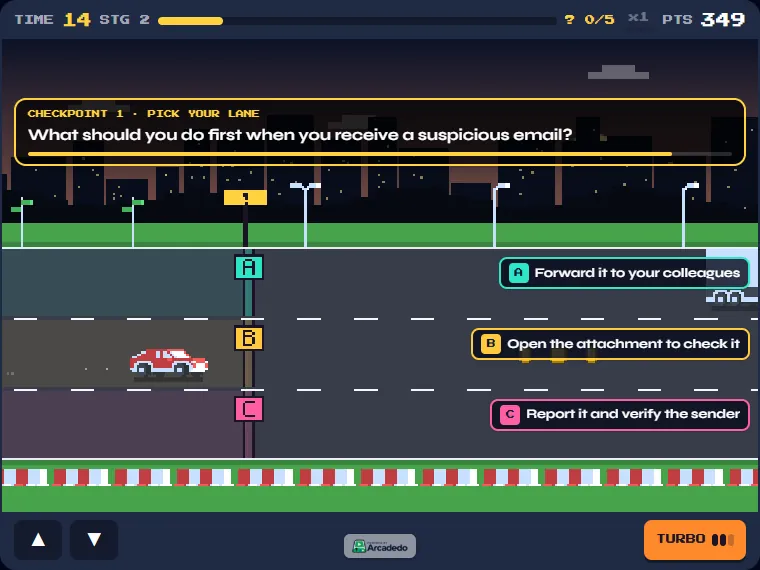
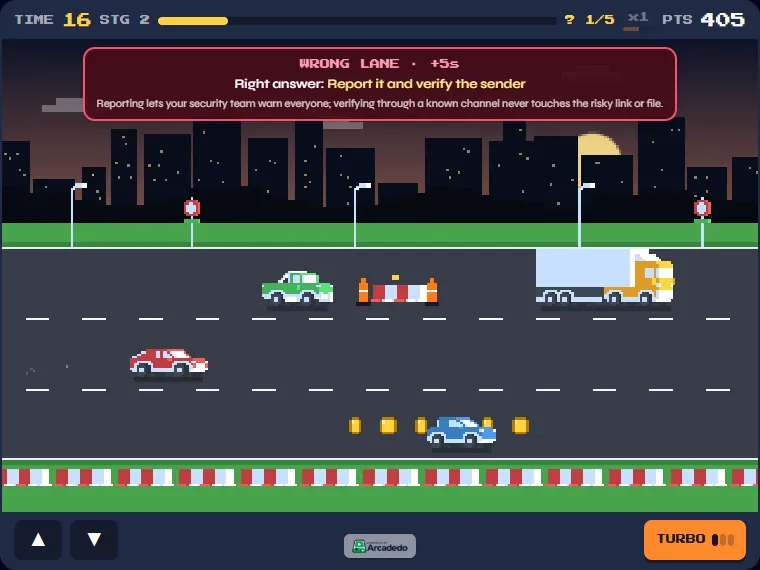
In Checkpoint Rush and Outpost Defense, the explanation appears straight after the answer, and missed questions come back on the results screen with the right answer. The Checkpoint Rush setup guide shows where to write them.
Can AI write the questions for you?
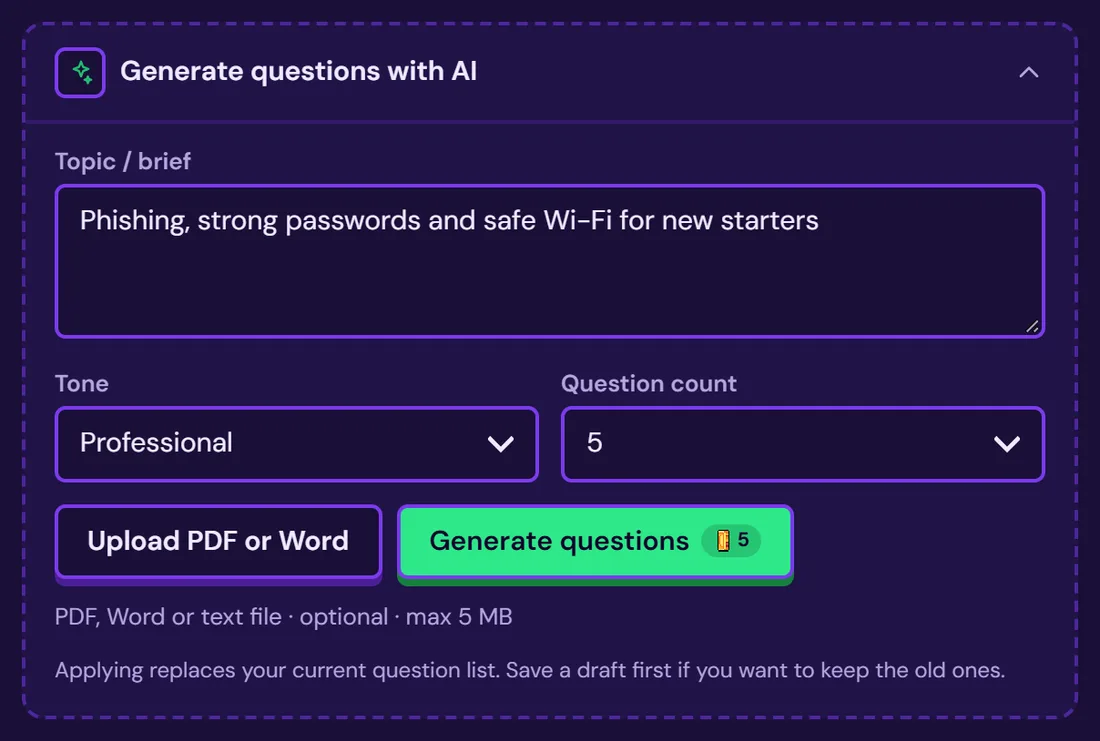
AI can draft them, but you still edit them. In the Content step, click Generate with AI, describe the topic or upload a PDF, Word or text file up to 5 MB, and choose how many questions you want. Each batch costs 5 credits, refunded if it fails. Then apply the checklist above: AI drafts often include trivia and weak distractors.
The Add questions or facts guide covers the editor, and our walkthrough on how to turn a PDF policy into a quiz game shows the whole process. After launch, Arcadedo's analytics list the questions players miss most. A question almost everyone misses is either badly written or covers something the training did not teach well; check the question first.
For where quiz games fit in a wider programme, see our guide to gamification in employee training. To try your questions in a game now, open Checkpoint Rush and click Use This Template.
Frequently asked questions
How many answer options should a multiple-choice question have?
Three: one right answer and two plausible wrong ones. Research shows a fourth or fifth option rarely improves the question, because extra wrong answers are usually weak. Use four only when you have three mistakes people genuinely make.
Should I use "all of the above" in a training quiz?
No. People who spot two correct options can choose "all of the above" without knowing the third, and the option tells you little about what they understand. Write one best answer instead.
How long should a multiple-choice question be?
Keep the stem to one or two sentences and each answer to a short phrase. In a quiz game, aim for a one-line stem and answers of a few words, because people read them on a phone while the game is running.
How do I know if a question is badly written?
Look at the results. If almost everyone gets it right, it may be too easy or give away the answer. If almost everyone picks the same wrong answer, the question is unclear or the training missed that point. Read the question again before re-teaching.