
How many questions should a training quiz have?
Five to ten questions for practice or a knowledge check, 10 to 20 for a scored end-of-course assessment. How to size a training quiz by learning objective, time, answer options and pass mark, with the research behind each rule.
The Arcadedo team, Gametize
8 min read

Give a training quiz five to ten questions when it is practice or a knowledge check on one topic, and 10 to 20 when it is a scored end-of-course assessment. Write one to three questions per learning objective, keep practice runs to a few minutes, and split anything longer into several short quizzes.
Most answers to this question give a single number and no reason. The number depends on the job the quiz is doing. A quiz that helps people practise has different needs from a quiz that decides whether someone passed. This guide separates the two, shows what research does and does not say, and covers the details that change the count: learning objectives, time, answer options and the pass mark.
How many questions should a training quiz have?
Five to ten questions for a quiz whose job is practice: a knowledge check after a module, a refresher, a quiz game people replay. Ten to twenty for a scored assessment that covers a whole course. Above about twenty, split the quiz into sections or separate quizzes, because long quizzes tire people and get abandoned.
| Quiz type | Job | Questions | Time per run |
|---|---|---|---|
| Knowledge check after one module | Make people recall what they just saw | 3–5 | 1–2 minutes |
| Practice quiz or quiz game | Repeated recall, spaced over weeks | 5–10 | 2–5 minutes |
| End-of-course assessment | Decide who passed | 10–20 | 10–20 minutes |
| Certification or regulated exam | Defend a pass/fail decision | Set by the awarding body | As specified |
These are working rules, not findings from a single study. The sections below explain where they come from, so you can adjust them for your own content.
Is there research on the ideal number of quiz questions?
No study fixes an ideal number of questions for a training quiz. Research answers two nearby questions instead: whether quizzing helps people remember (it does, especially when repeated and spaced out), and how test length affects how reliable a score is. Those two findings point in different directions, which is why practice quizzes and assessments need different lengths.
Practice: frequent and short wins. Taking a test improves long-term retention more than restudying the same material, an effect known as test-enhanced learning (Roediger and Karpicke, 2006, Psychological Science). A study of more than 10,000 employees found that the gaps between practice sessions mattered more the longer people had to remember (Kim et al., 2019). Both favour several short quizzes over one long one: what helps is retrieving the answer again, later.
Assessment: more questions, steadier scores. A score based on three questions swings a lot with luck: one guess more or less changes it by a third. Each extra well-written question makes the score a more stable measure of what someone knows. That is the reason a pass/fail assessment needs more questions than a practice run, and why high-stakes exams run long.
How many questions per learning objective?
Write one to three questions for each learning objective. One question checks that the idea landed; two or three, phrased as different situations, check that people can apply it rather than recognise the wording. Count your objectives first, then multiply. If the total runs past ten, the topic needs more than one quiz.
A worked example for a module on reporting a data breach:
| Learning objective | Questions |
|---|---|
| Recognise what counts as a breach | 2 |
| Know who to tell, and how fast | 2 |
| Know what not to do (delete, investigate alone) | 2 |
| Find the reporting form | 1 |
| Total | 7 |
Seven questions, about three minutes as a game. If an objective only earns a question because it is easy to ask ("Which section of the policy covers breaches?"), cut it. Our guide to compliance training games has more on choosing which rules deserve a question.
How long should a training quiz take?
A practice quiz should take two to five minutes, and a knowledge check one or two. People finish a short run and are willing to replay it, and replays are where the practice happens. An end-of-course assessment can take ten to twenty minutes, because people expect it and sit down for it.
Time depends on the question as much as the count. A short recall question takes seconds; a scenario with a paragraph to read takes much longer. The only reliable way to know is to play the quiz yourself at a normal pace and time it. In Arcadedo the editor's preview plays the full game, so you can time a run before you publish. Game timers also shape the length: Turbo Quiz Racer has a per-question timer you can set from 10 to 60 seconds.
How many answer options should each question have?
Three answer options work as well as four or five for most multiple-choice questions. A meta-analysis of 80 years of research concluded that three options are optimal in most settings, because a fourth or fifth option is usually a weak distractor nobody picks (Rodriguez, 2005, Educational Measurement: Issues and Practice).
What matters more than the count is that every wrong answer is tempting. Write wrong answers from the mistakes people really make ("Finish the task, then report it") rather than obvious fillers ("Ignore it"). Fewer, better options also let you write more questions in the same time.
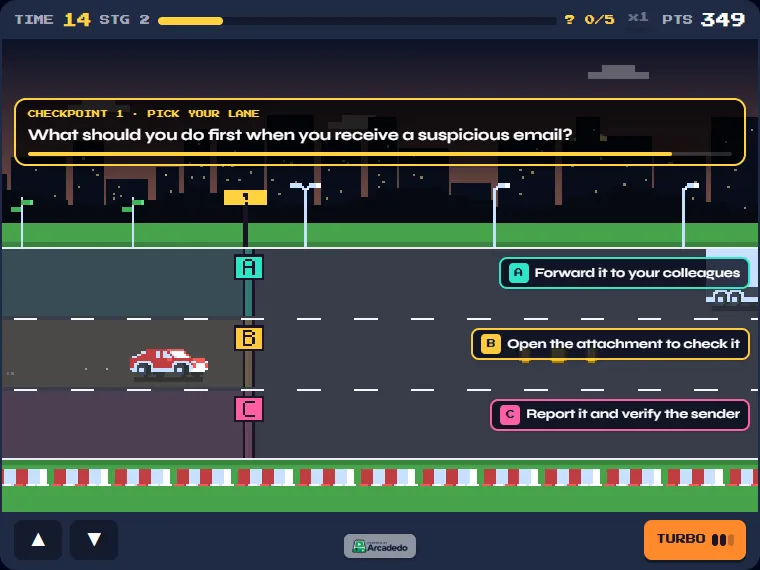
In Arcadedo, quiz questions take two to four answer choices. Checkpoint Rush always shows three, one per highway lane: the right answer and two others.
How does the pass mark change the number of questions?
Choose a question count that your pass mark divides cleanly. With an 80 percent pass mark, five, ten, fifteen or twenty questions give a whole number of correct answers; eight questions do not, so the real bar becomes seven out of eight, or 87.5 percent. Check the arithmetic before you publish, or the quiz is harder than you meant.
| Questions | 70% pass | 80% pass | 90% pass |
|---|---|---|---|
| 5 | 4 of 5 (80%) | 4 of 5 | 5 of 5 (100%) |
| 8 | 6 of 8 (75%) | 7 of 8 (87.5%) | 8 of 8 (100%) |
| 10 | 7 of 10 | 8 of 10 | 9 of 10 |
| 20 | 14 of 20 | 16 of 20 | 18 of 20 |
Short quizzes also make each question count for more. With five questions, one slip is 20 percent of the score, so a strict pass mark on a short practice quiz fails people who know the topic. Keep strict marks for longer assessments, and set practice games to be passable by anyone who has done the training.
How do you set a pass score in a quiz game?
In Arcadedo the pass score is in points, not percent. Work out the points for the number of correct answers you require (points per correct answer times that number), subtract any wrong-answer penalty you have switched on, then play a run in the preview. Combos and bonuses add points in some games, so check that a player who misses more than you allow does not pass.
Lives limit mistakes too: in Turbo Quiz Racer each wrong answer costs a life, and you can set from one to five. Turn timers and lives up for a gentle first run, down for a challenge.
How many questions fit in an Arcadedo game?
Each Arcadedo quiz template takes up to ten questions, which matches the practice range above. Real or Fake takes up to twenty cards, because each swipe is a quick judgement rather than a full question. Outpost Defense asks one question per wave except the last, so its number depends on the waves you set.
| Template | Questions per game | How they are asked |
|---|---|---|
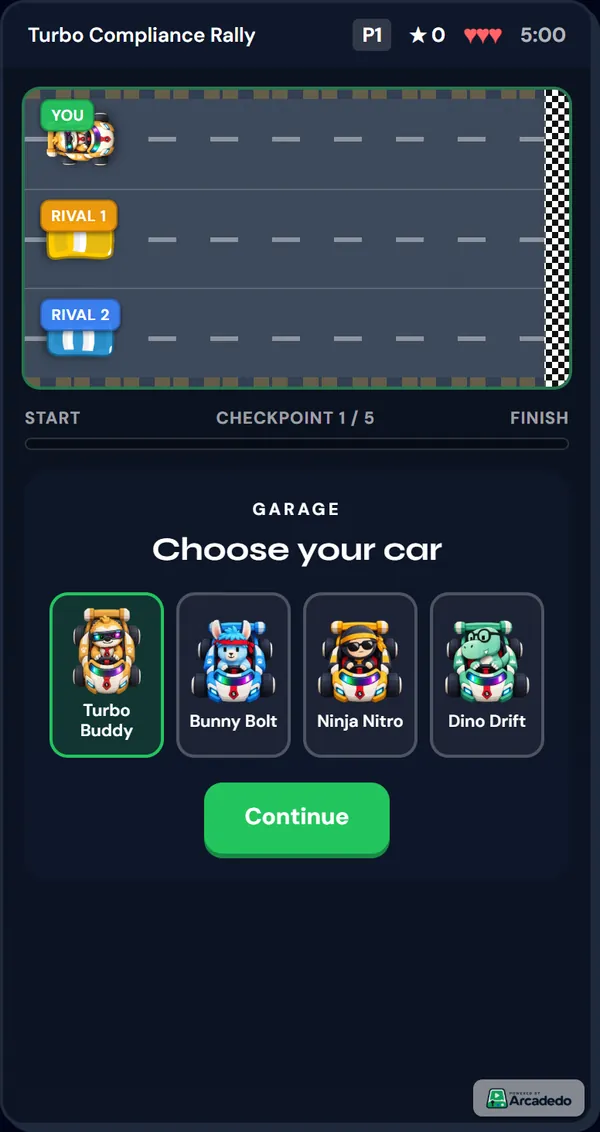
| Turbo Quiz Racer | Up to 10 | One per checkpoint; correct answers move the car toward the finish |
| Checkpoint Rush | Up to 10 | Every third checkpoint (every second with more than six questions) |
| Outpost Defense | 2 to 7 | A supply crate after every wave but the last; you set 3 to 8 waves |
| Space Shooter, Dino Run, Star Match | Up to 10 | Triggered by a star, a golden egg or a glowing tile |
| Real or Fake | Up to 20 cards | Swipe right for real, left for fake |
The setup guides for Checkpoint Rush and Outpost Defense explain how questions are spread through each run. Our guide to choosing a game template compares every format.
What do you do when you have more than ten questions?
Split them by learning objective into several short quizzes, and send them a week or two apart. A 30-question bank becomes three games of ten, each with one clear outcome. People finish each one, the spacing helps them remember, and the analytics tell you which topic is weakest instead of blurring everything into one score.
- Group the questions by objective. Each group becomes one game with its own title, such as "Reporting a breach" or "Spotting phishing".
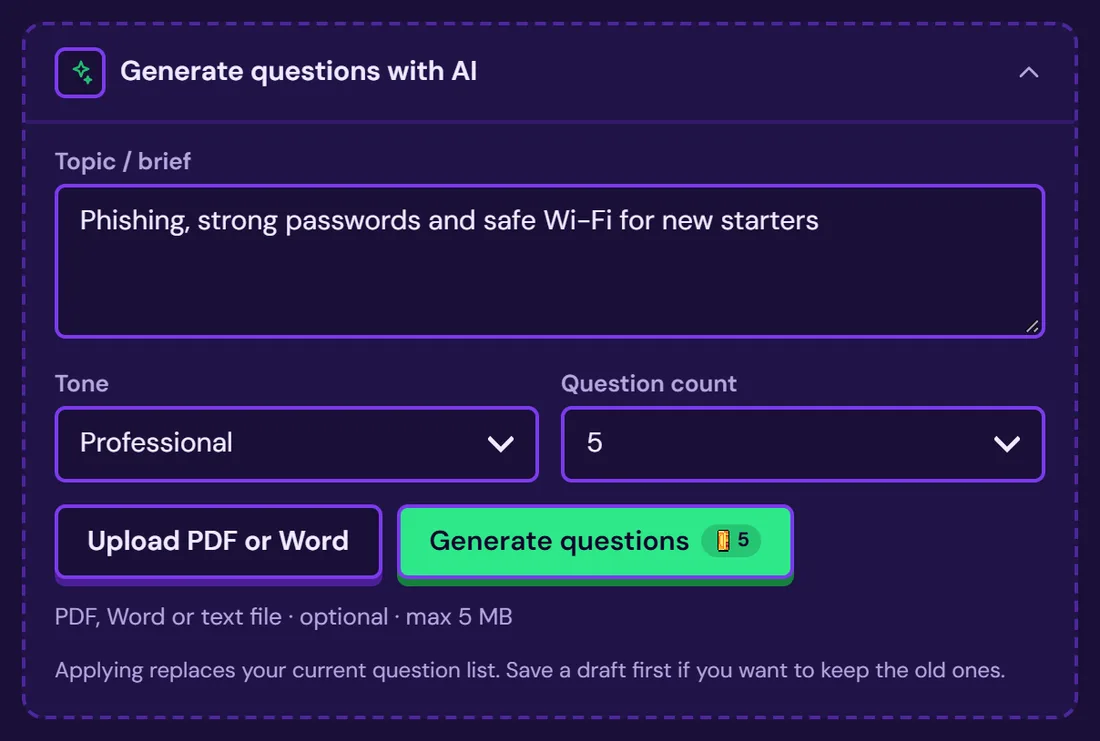
- Draft fast, then cut. In the Content step, click Generate with AI, upload your policy as a PDF, Word or text file up to 5 MB, and pick how many questions you want. Each batch costs 5 credits, refunded if it fails. Then delete the trivia. See Add questions or facts, or our guide to turn a PDF policy into a quiz game.
- Publish and space them. Publish each game and send the links in sequence. Editing a published game keeps the same link, so you can swap questions later without a new invitation.
- Read the results. Arcadedo's analytics show completion rate, pass rate, average time and the questions players miss most. A low completion rate says the game is too long; a most-missed question says what to re-teach.
If you are still deciding whether a plain quiz or a game suits the job, our comparison of a quiz or a game as a knowledge check covers both, and our guide to gamification in employee training shows where short quiz games fit in a wider programme. To build one now, turn a quiz into an arcade game with any of the game templates.
Frequently asked questions
Is 10 questions enough for a training quiz?
Yes, for practice or a knowledge check on one topic. Ten questions cover three to five learning objectives and take a few minutes. For a scored assessment of a whole course, ten is the minimum; 15 to 20 gives a steadier score.
How many questions should a compliance quiz have?
Five to ten per game, one policy area per game, for practice. If the quiz is your formal record of completion, follow your regulator's or LMS's assessment rules and keep the game as the practice before it.
Should every player get the same questions?
For short practice games, yes: a fixed set of five to ten questions people replay is how the practice happens, and it keeps the analytics comparable. Rotate questions between campaigns instead, by editing the game or publishing a new one for the next topic.
How many questions should I generate with AI?
Ask for a few more than you need, then cut. In Arcadedo you choose the count before you click Generate questions, and every drafted question stays editable. Keep the ones that test an objective, and delete the ones that only test whether someone read the document.