Gamification in workforce development: how to build skills that stick
Gamification in workforce development works best as spaced practice, not a one-off fun course: a three-minute game per skill, replayed every few weeks, scored against a pass mark and read for gaps. Where games fit in a skills programme, a 12-week plan, what the research says and what to measure.
The Arcadedo team, Gametize
9 min read
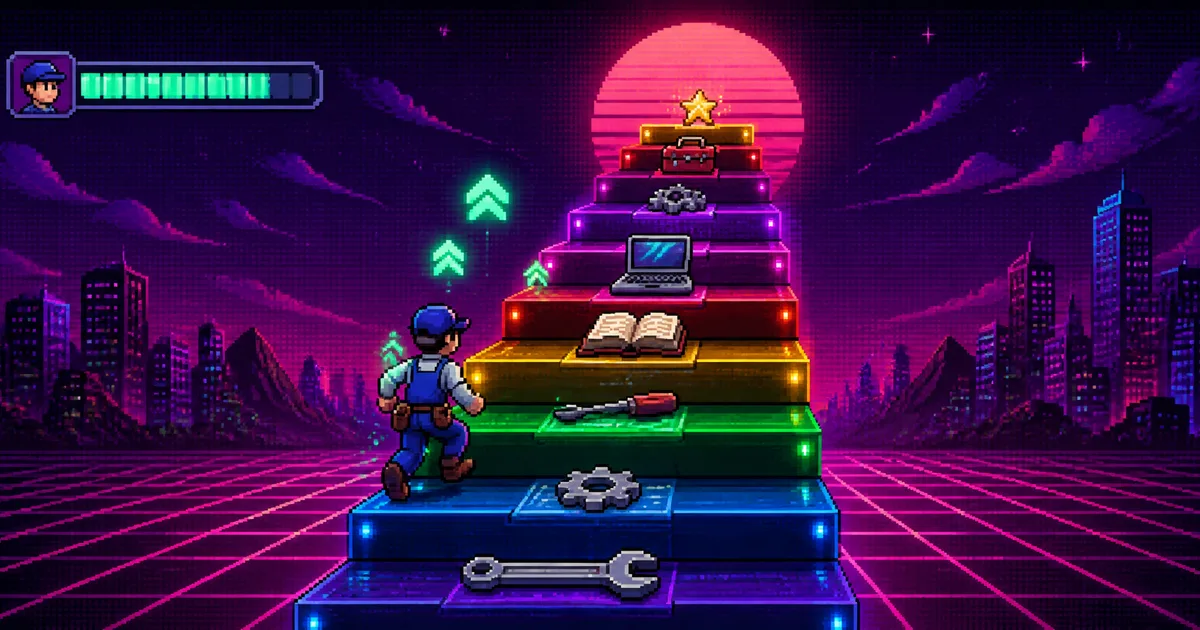
Gamification in workforce development means using short games and game elements to build and keep the skills a workforce needs over months, not just to liven up one course. It works best as spaced practice: a three-minute game per skill, replayed every few weeks, scored against a pass mark and read for gaps.
Most articles on this topic stop at points, badges and leaderboards, and back them with percentages nobody can trace to a study. This guide treats workforce development as what it is, a skills programme that runs for months, and shows where games fit in it, how to space them, and how to tell whether they worked. For the basics of game-based training, start with our guide to gamification in employee training.
What is gamification in workforce development?
Gamification in workforce development is the use of games and game elements, such as scores, pass marks, levels and instant feedback, inside programmes that build a workforce's skills over time: upskilling, reskilling, certification, refreshers and readiness checks. The difference from gamifying a single course is time. The goal is skills people still have in six months.
The pressure behind it is real. In the World Economic Forum's Future of Jobs Report 2025, employers expect 39% of workers' core skills to change by 2030, and 85% say they plan to prioritise upskilling their workforce. That is a lot of learning to deliver, and a lot to keep from fading once the course ends.
Games help with the second part. A short game is cheap to replay, so it can carry the repeated practice that makes skills last, which a two-hour workshop cannot.
Does gamification work for workforce development?
Yes, modestly, and mostly when it makes people practise. A meta-analysis of 40 experiments found small but significant positive effects of gamification on learning, motivation and behaviour. The bigger gains come from what the game makes people do, retrieve and repeat, not from badges. Treat vendor statistics without a named study with caution.
The meta-analysis is Sailer and Homner (2020): effect sizes of g = 0.49 for cognitive outcomes, 0.36 for motivation and 0.25 for behaviour. The cognitive effect held up in the most rigorous studies; the motivation and behaviour effects were less stable. Most studies came from education, not workplaces.
The stronger evidence is about spacing. In a study of more than 1,350 people, Cepeda and colleagues (2008) found that the best gap between study and review grows with how long people need to remember: about 20–40% of the delay for a one-week test, falling to about 5–10% for a one-year test. A workplace study of more than 10,000 employees found that spacing mattered more the longer people had to remember (Kim et al., 2019). Short games are an easy way to deliver those spaced reviews.
Where do games fit in a workforce development programme?
Games fit at four points: a baseline before training, practice straight after it, a readiness check before people use the skill for real, and refreshers in the months after. They do not replace the teaching itself: a coach, a course or on-the-job shadowing still does that. Use the game to find gaps and keep the skill from fading.
| Stage | What the game does | Good template |
|---|---|---|
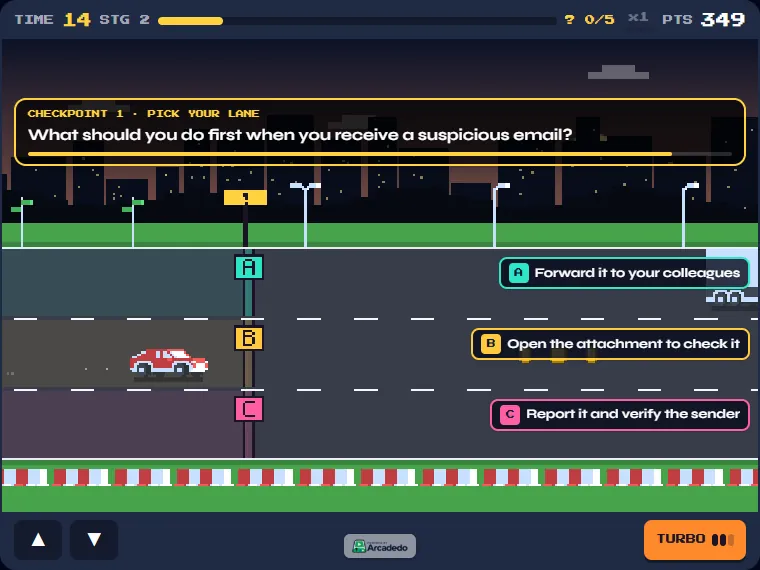
| Baseline | Shows what people already know, so training skips the easy parts | Turbo Quiz Racer or Checkpoint Rush |
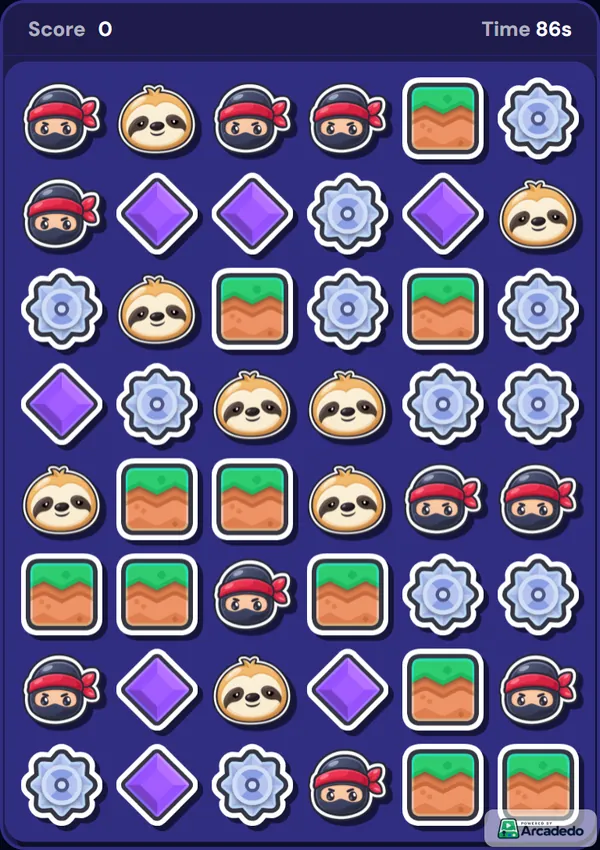
| Practice | Turns new knowledge into recall, right after the session | Star Match |
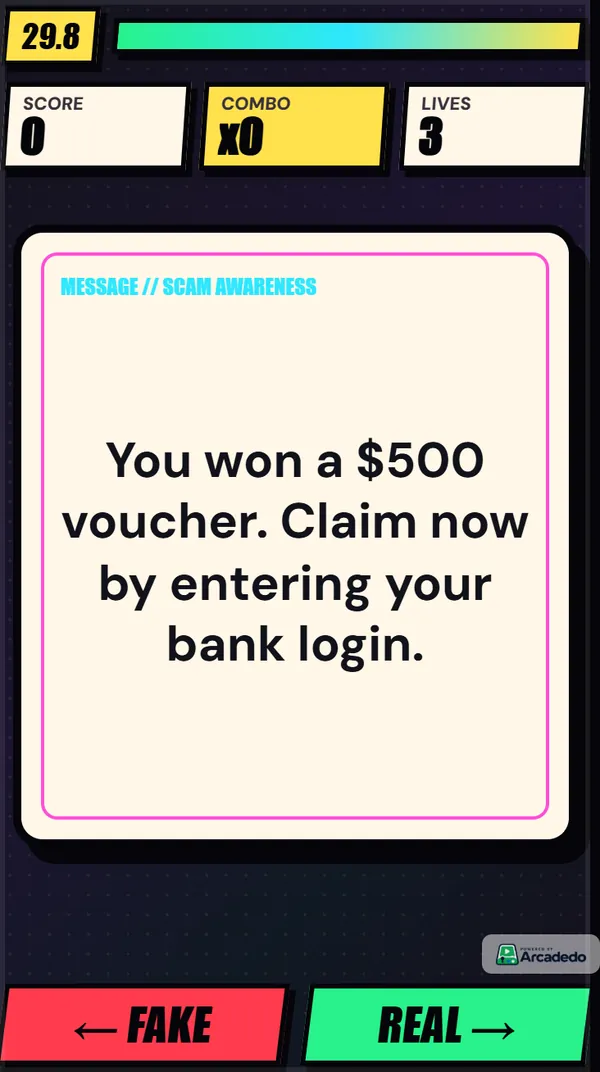
| Judgement drill | Trains spotting the right and wrong way, case by case | Real or Fake |
| Readiness check | Confirms the skill against a pass mark before go-live | Checkpoint Rush |
| Refresher | Brings the skill back weeks later, before it fades | Outpost Defense or Star Match |
| Awareness | Shares facts with no test, for low-stakes topics | Mini Maze |
How do you gamify upskilling and reskilling?
Start from the skill, not the game. Pick one skill from your skills matrix, write questions about the decisions it involves, run a baseline, practise right after training, then replay the same game at widening gaps and set a pass mark. Read the most-missed questions after each round and fix the training, not just the scores.
- Pick one skill. "Process a return under the new policy" is a skill. "Customer service" is a department. One game per skill keeps it to three minutes.
- Write decision questions. Ask what people must decide on the job: "A customer returns an item after 35 days with a receipt. What do you offer?" Our guide on how to write multiple-choice questions covers stems, options and explanations.
- Keep it short. Eight to twelve questions is enough for one skill; see how many questions a training quiz should have.
- Run a baseline. Send the game before the training. People who already pass can skip a module.
- Practise straight after. Send the same game, or a Star Match version, the day after the session.
- Space the replays. Replay at one week, three weeks and six weeks, then quarterly. Reorder the questions and swap a few each time.
- Set a pass mark and read the misses. If most people miss the same question, the training or the question is wrong, not the people.
What does a 12-week gamified skills plan look like?
A 12-week plan uses one game per skill on a widening schedule: baseline in week 0, practice in week 1, a judgement drill in week 2, a readiness check in week 3, then refreshers in weeks 6 and 12. Each game takes three to five minutes, so the whole plan costs each person well under an hour of play.
Example: a customer-service team moving to a new product line.
| Week | Game | Purpose | Time |
|---|---|---|---|
| 0 | Baseline quiz race (10 questions) | Find what people already know | 3 min |
| 1 | Training sessions, then Star Match practice | Turn the session into recall | 4 min |
| 2 | Real or Fake: "right answer to the customer, or not?" | Practise judgement on real cases | 3 min |
| 3 | Readiness check with a pass mark | Confirm before taking live calls | 5 min |
| 6 | Refresher: the same questions, reordered, a few swapped | Stop the skill fading | 3 min |
| 12 | Refresher focused on the most-missed questions | Fix lasting gaps | 3 min |
Change the week numbers to fit your timeline. For a skill people need for a year, the Cepeda research suggests later reviews spaced weeks apart, not days. The same pattern works for product knowledge training games, safety refreshers and compliance training games.
How do you reach frontline and deskless workers?
Send a link that opens on a phone and finishes in a few minutes. Frontline staff rarely sit at a desk or log into a learning system, so the game has to fit a break, a shift handover or a toolbox talk. Post it where they already look: a team chat, a shift message, a QR code on the break-room wall.
- Phone first. Arcadedo games play in the browser on phones and desktops, from one link (Share your game link).
- Short by design. One skill, three minutes. A game that needs twenty minutes will not get played on a break.
- One place for the programme. If you run campaigns in Gametize, embed each game as a challenge so progress sits in one place (Embed in Gametize).
- No public ranking across shifts. Night shift should not lose to day shift because it had less time to play. Compare people against the pass mark.
How do you measure gamified workforce development?
Measure skills, not play. Completion tells you the link reached people; the pass rate, the most-missed questions and the change from baseline to refresher tell you whether skills grew and stuck. Then check the job itself: fewer errors, fewer escalations, faster time to competence. The Kirkpatrick model is a simple frame for this.
| Level (Kirkpatrick model) | Question | What to look at |
|---|---|---|
| 1. Reaction | Did people engage? | Players, completion rate, plays per player |
| 2. Learning | Did they learn it? | Pass rate and average score, baseline vs readiness check |
| 3. Behaviour | Do they use it at work? | Manager observation, quality checks, errors on the job |
| 4. Results | Did the business gain? | The metric the skill exists for: returns handled right first time, incidents, time to competence |
Each Arcadedo game has an analytics page showing players, plays per player, completion rate, pass rate, average score and the most-missed questions. Levels 3 and 4 come from your own systems. Keep the first cohort as a pilot and change one thing at a time.
What mistakes should you avoid?
Avoid gamifying activity instead of skill. Points for logging in, badges for finishing modules and league tables across teams all measure attendance. They can also push people to game the system rather than learn. Keep the game about decisions people make at work, keep scores private or against a pass mark, and keep coming back.
- One launch, then nothing. A game played once is a quiz. The value comes from the replays at weeks 3, 6 and 12.
- Rewarding activity. Points for logins and video views teach people to log in and watch videos.
- Trivia. "What year was the product launched?" does not change how anyone does their job.
- Leaderboards across unequal groups. Shifts, regions and new starters do not start equal. Ranking them punishes circumstance.
- Ignoring the misses. If 70% of players miss a question, the question or the training needs fixing first.
For a comparison of platforms that do points-and-badges at scale versus short branded games, see the best gamification tools for employee training. For new hires, see our onboarding gamification examples.
How do you build a skills game in Arcadedo?
Pick a template, add your questions, set a pass score, brand it and publish a link. Building and hosting games in Arcadedo is free, and a first game takes about ten minutes. Credits are only used for optional AI help and for removing the small Arcadedo badge.
- Pick a template. Open Templates, click Preview & Play, then Use This Template. For a readiness check, start with Checkpoint Rush.
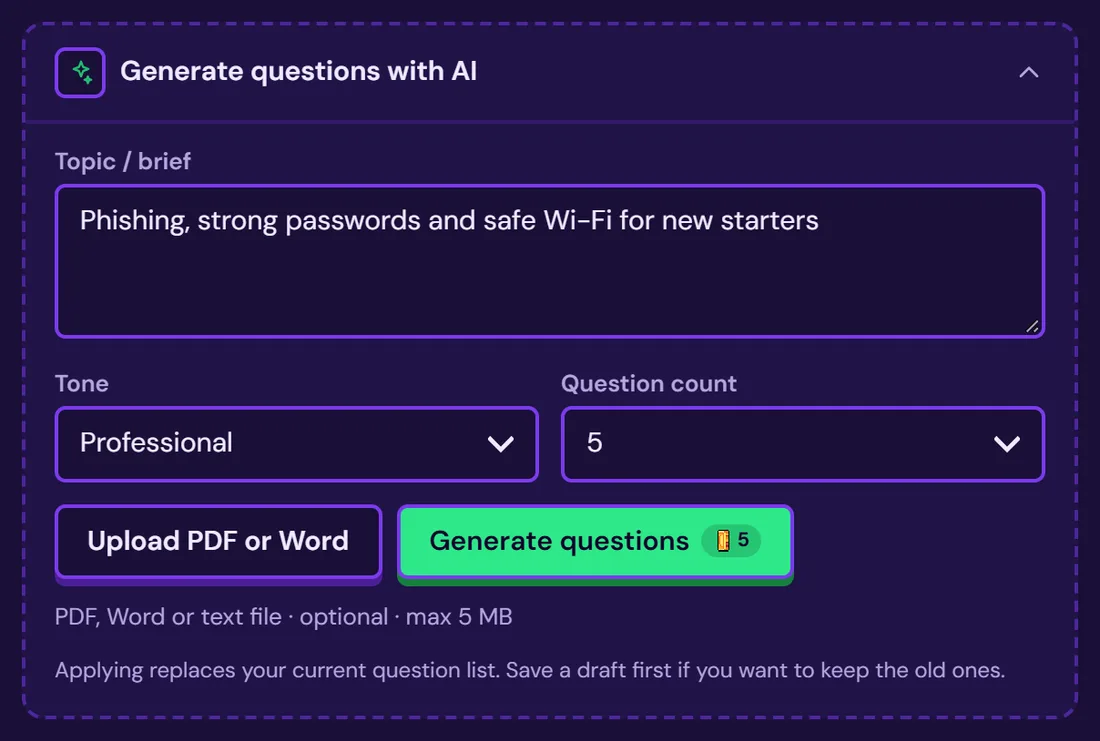
- Add your questions. Type them in the Content step, or click Generate with AI to draft them from a topic or an uploaded PDF, Word or text file (5 credits per batch). Edit every draft. The Add questions or facts guide shows how.
- Set a pass score and brand it. Add your logo and colours so it looks like your programme.
- Publish and share. One click gives a link. Send it at each point in your plan, and reuse the same link for every refresher.
When the skill or policy changes, edit the game and the link keeps working, so the next refresher uses the new version.
Frequently asked questions
What is an example of gamification in workforce development?
A customer-service team moving to a new product line plays a three-minute quiz race before training as a baseline, a match-3 practice game the day after, a readiness check with a pass mark before taking live calls, and the same questions again at six and twelve weeks to stop the skill fading.
Can gamification help with upskilling and reskilling?
Yes, as a way to practise and keep new skills, not to teach them from scratch. Use a baseline game to skip what people already know, short games right after training to build recall, and spaced refreshers in the following weeks. Read the most-missed questions to see where training needs work.
What are the disadvantages of gamification in the workplace?
Badly designed gamification rewards activity instead of learning, ranks people who did not start equal, and fades after launch. Points for logins and public league tables can push people to game the system. Keep games short, about real decisions, scored against a pass mark, and repeated over time.
How often should employees replay a training game?
Replay at widening gaps: the day after training, then about one, three and six weeks later, then quarterly for skills needed all year. Research on spacing found the best gap grows with how long people must remember, so later reviews should be spaced further apart than early ones.